Understanding Posture, Alignment & Metrics
Experimental Movement Observation Notice: TangoPosture Community Edition provides experimental movement observation for dance practice and teaching. It is not a medical assessment, clinical diagnosis, or judgement of artistic tango quality.
Understanding Posture, Alignment, Balance & Pivots
Metrics summarize projected body alignment relative to your calibrated neutral posture. When tracking confidence drops, values remain explicitly unknown.
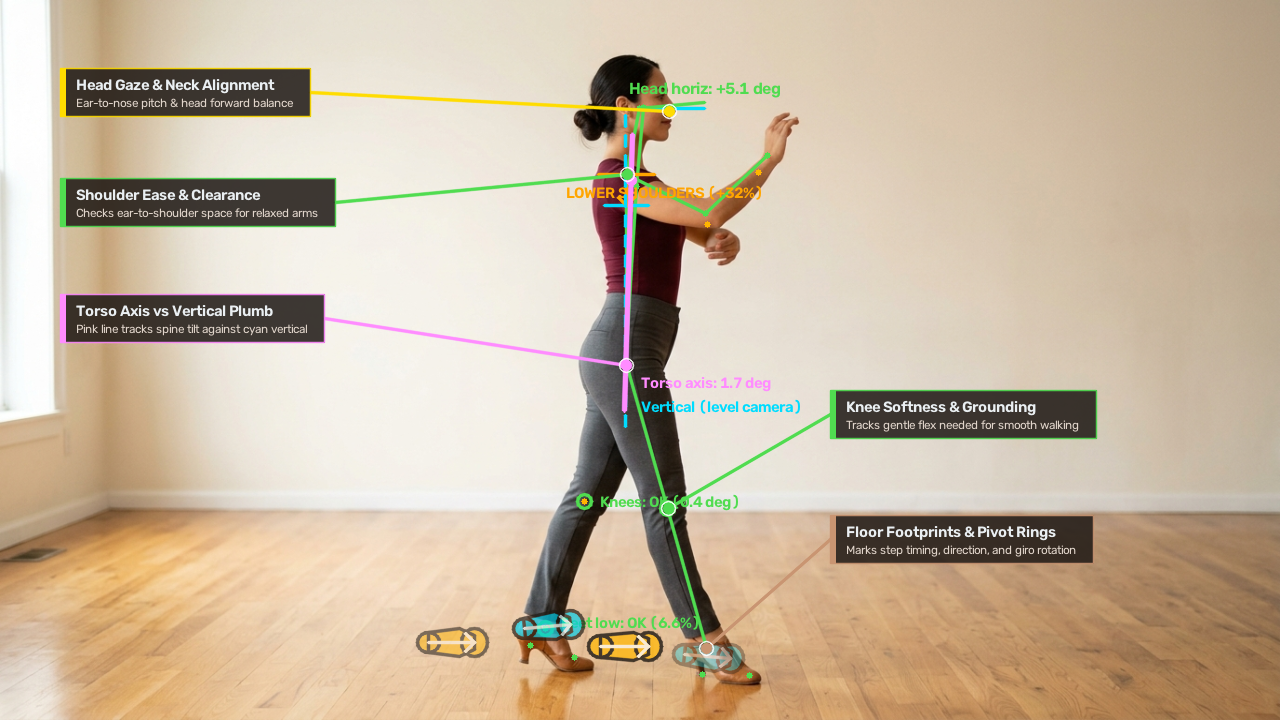
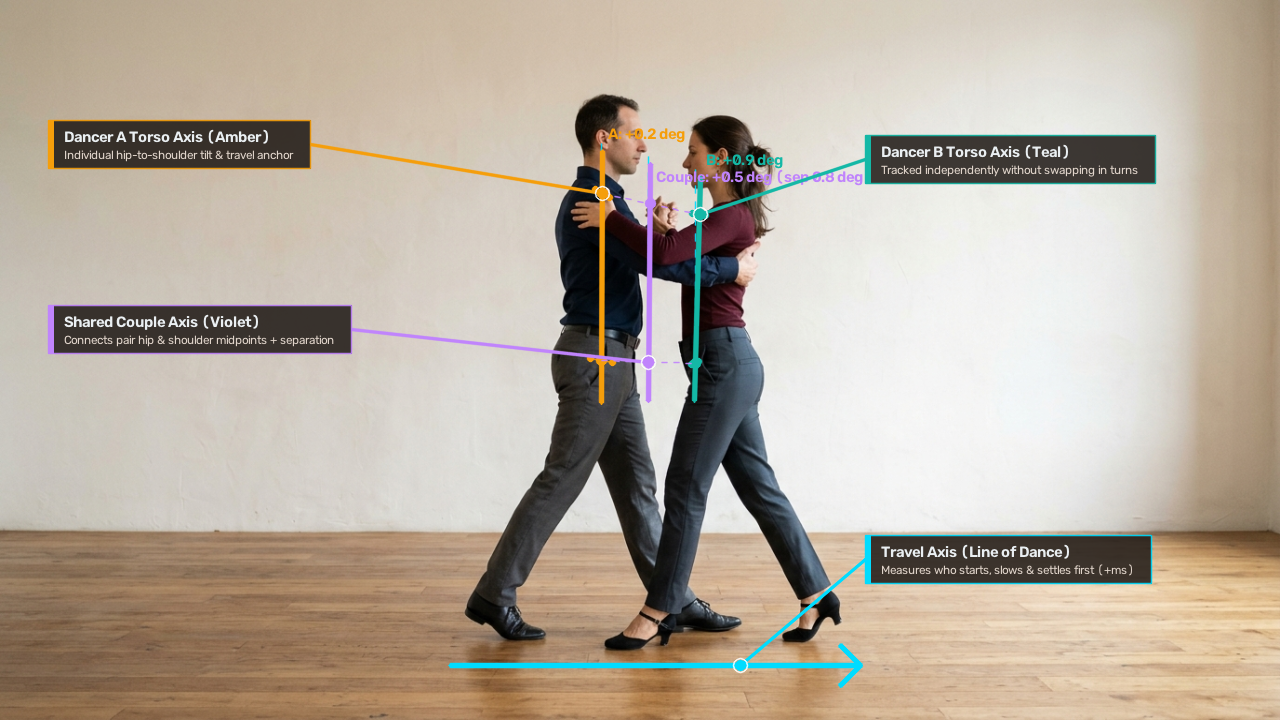
Head Forward (head_forward)
- What it observes: Measured
head_forwardposture observable defined insrc/tango_posture/domain.py. - Why it may be useful to a dancer: Helps dancers and teachers notice movement habits around head forward during solo or couple practice.
- How to interpret the result: Values are reported in
torso_lengths(configured thresholds:head_down_duration=Field(default=3.0, gt=0),head_down_angle=Field(default=-15.0, lt=0),head_forward=Threshold(entry=0.08, clear=0.05)). Compare trends across your own calibrated sessions rather than treating single-frame spikes as errors. - Practical example: Record a 10–15 second passage after approving your personal calibration, then review whether the timeline stays within your target band or shows repeated alerts.
- Relevant limitations: Single-camera monocular pose estimation degrades under occlusion or low lighting.
- When the measurement may be unreliable: Explicitly emits None / UNKNOWN; does not fabricate approximations.
Head Inclination (head_inclination)
- What it observes: Measured
head_inclinationposture observable defined insrc/tango_posture/domain.py. - Why it may be useful to a dancer: Helps dancers and teachers notice movement habits around head inclination during solo or couple practice.
- How to interpret the result: Values are reported in
degrees(configured thresholds:head_down_duration=Field(default=3.0, gt=0),head_down_angle=Field(default=-15.0, lt=0),head_inclination=Threshold(entry=10, clear=6)). Compare trends across your own calibrated sessions rather than treating single-frame spikes as errors. - Practical example: Record a 10–15 second passage after approving your personal calibration, then review whether the timeline stays within your target band or shows repeated alerts.
- Relevant limitations: Single-camera monocular pose estimation degrades under occlusion or low lighting.
- When the measurement may be unreliable: Explicitly emits None / UNKNOWN; does not fabricate approximations.
Trunk Inclination (trunk_inclination)
- What it observes: Measured
trunk_inclinationposture observable defined insrc/tango_posture/domain.py. - Why it may be useful to a dancer: Helps dancers and teachers notice movement habits around trunk inclination during solo or couple practice.
- How to interpret the result: Values are reported in
degrees(configured thresholds:trunk_inclination=Threshold(entry=8, clear=5)). Compare trends across your own calibrated sessions rather than treating single-frame spikes as errors. - Practical example: Record a 10–15 second passage after approving your personal calibration, then review whether the timeline stays within your target band or shows repeated alerts.
- Relevant limitations: Single-camera monocular pose estimation degrades under occlusion or low lighting.
- When the measurement may be unreliable: Explicitly emits None / UNKNOWN; does not fabricate approximations.
Prepare Side Measurement Frame (prepare_side_measurement_frame)
- What it observes: Repair occluded far-side torso joints in side view so near-side measurements stay valid.
- Why it may be useful to a dancer: Helps dancers and teachers notice movement habits around prepare side measurement frame during solo or couple practice.
- How to interpret the result: Values are reported in
unverified. Compare trends across your own calibrated sessions rather than treating single-frame spikes as errors. - Practical example: Record a 10–15 second passage after approving your personal calibration, then review whether the timeline stays within your target band or shows repeated alerts.
- Relevant limitations: Subject to camera framing, clothing contrast, and landmark occlusion.
- When the measurement may be unreliable: Returns None (explicitly untracked) rather than synthetic values.
Ledger Metric Samples (ledger_metric_samples)
- What it observes: Compute metric time series honoring per-phase side/facing ledger entries.
- Why it may be useful to a dancer: Helps dancers and teachers notice movement habits around ledger metric samples during solo or couple practice.
- How to interpret the result: Values are reported in
unverified. Compare trends across your own calibrated sessions rather than treating single-frame spikes as errors. - Practical example: Record a 10–15 second passage after approving your personal calibration, then review whether the timeline stays within your target band or shows repeated alerts.
- Relevant limitations: Subject to camera framing, clothing contrast, and landmark occlusion.
- When the measurement may be unreliable: Returns None (explicitly untracked) rather than synthetic values.
Evaluate Metric Repeat Check (evaluate_metric_repeat_check)
- What it observes: Run repeat_check() on neutral A, changed A, neutral B, changed B plus optional sign check.
- Why it may be useful to a dancer: Helps dancers and teachers notice movement habits around evaluate metric repeat check during solo or couple practice.
- How to interpret the result: Values are reported in
unverified. Compare trends across your own calibrated sessions rather than treating single-frame spikes as errors. - Practical example: Record a 10–15 second passage after approving your personal calibration, then review whether the timeline stays within your target band or shows repeated alerts.
- Relevant limitations: Subject to camera framing, clothing contrast, and landmark occlusion.
- When the measurement may be unreliable: Returns None (explicitly untracked) rather than synthetic values.
Measure Ranges (measure_ranges)
- What it observes: Use only confidence-qualified landmarks and existing measurement definitions.
- Why it may be useful to a dancer: Helps dancers and teachers notice movement habits around measure ranges during solo or couple practice.
- How to interpret the result: Values are reported in
unverified. Compare trends across your own calibrated sessions rather than treating single-frame spikes as errors. - Practical example: Record a 10–15 second passage after approving your personal calibration, then review whether the timeline stays within your target band or shows repeated alerts.
- Relevant limitations: Subject to camera framing, clothing contrast, and landmark occlusion.
- When the measurement may be unreliable: Returns None (explicitly untracked) rather than synthetic values.
Measure Profile (measure_profile)
- What it observes: Use the same per-view measurement path in approval and subsequent scoring.
- Why it may be useful to a dancer: Helps dancers and teachers notice movement habits around measure profile during solo or couple practice.
- How to interpret the result: Values are reported in
unverified. Compare trends across your own calibrated sessions rather than treating single-frame spikes as errors. - Practical example: Record a 10–15 second passage after approving your personal calibration, then review whether the timeline stays within your target band or shows repeated alerts.
- Relevant limitations: Subject to camera framing, clothing contrast, and landmark occlusion.
- When the measurement may be unreliable: Returns None (explicitly untracked) rather than synthetic values.
Measure Targets (measure_targets)
- What it observes: Metric computation
measure_targetsextracted fromsrc/tango_posture/calibration/measurements.py. - Why it may be useful to a dancer: Helps dancers and teachers notice movement habits around measure targets during solo or couple practice.
- How to interpret the result: Values are reported in
unverified. Compare trends across your own calibrated sessions rather than treating single-frame spikes as errors. - Practical example: Record a 10–15 second passage after approving your personal calibration, then review whether the timeline stays within your target band or shows repeated alerts.
- Relevant limitations: Subject to camera framing, clothing contrast, and landmark occlusion.
- When the measurement may be unreliable: Returns None (explicitly untracked) rather than synthetic values.
Metric Samples (metric_samples)
- What it observes: Metric computation
metric_samplesextracted fromsrc/tango_posture/calibration/measurements.py. - Why it may be useful to a dancer: Helps dancers and teachers notice movement habits around metric samples during solo or couple practice.
- How to interpret the result: Values are reported in
unverified. Compare trends across your own calibrated sessions rather than treating single-frame spikes as errors. - Practical example: Record a 10–15 second passage after approving your personal calibration, then review whether the timeline stays within your target band or shows repeated alerts.
- Relevant limitations: Subject to camera framing, clothing contrast, and landmark occlusion.
- When the measurement may be unreliable: Returns None (explicitly untracked) rather than synthetic values.
Measure Hold Window (measure_hold_window)
- What it observes: Measure one hold window on real frames without interpolation.
- Why it may be useful to a dancer: Helps dancers and teachers notice movement habits around measure hold window during solo or couple practice.
- How to interpret the result: Values are reported in
unverified. Compare trends across your own calibrated sessions rather than treating single-frame spikes as errors. - Practical example: Record a 10–15 second passage after approving your personal calibration, then review whether the timeline stays within your target band or shows repeated alerts.
- Relevant limitations: Subject to camera framing, clothing contrast, and landmark occlusion.
- When the measurement may be unreliable: Returns None (explicitly untracked) rather than synthetic values.
Metric Offset Between (metric_offset_between)
- What it observes: Compute signed offset
bmappingpractice_value + b -> reference_value. - Why it may be useful to a dancer: Helps dancers and teachers notice movement habits around metric offset between during solo or couple practice.
- How to interpret the result: Values are reported in
ratio. Compare trends across your own calibrated sessions rather than treating single-frame spikes as errors. - Practical example: Record a 10–15 second passage after approving your personal calibration, then review whether the timeline stays within your target band or shows repeated alerts.
- Relevant limitations: Subject to camera framing, clothing contrast, and landmark occlusion.
- When the measurement may be unreliable: Returns None (explicitly untracked) rather than synthetic values.
← Previous: Solo, Couple & Calibration Guide · Next: Understanding Overlays, Reports & Exercises →